
 Vietnam


RADDY'S REIGN – THE MAN WHO BUILT A DYNASTY FOR SINGAPORE
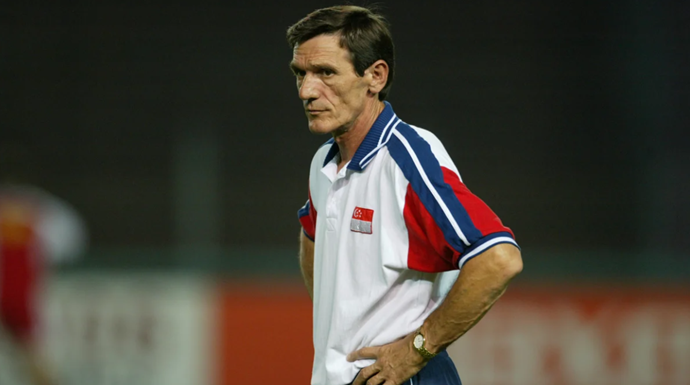
When the ASEAN Hyundai Cup™ 2026 kicks off next month in celebration of its landmark 30th anniversary, one name will stand above all others in the tournament's history.
Over 15 previous editions, no coach has guided a nation to more success in the ASEAN Championship than Radojko "Raddy" Avramović. The Serbian tactician steered Singapore to three of their four titles—in 2004, 2007, and 2012—transforming the island nation into a regional powerhouse for a decade. It is a golden era that current head coach Gavin Lee will be eager to rekindle when Singapore enters the Hyundai Cup™ from July 24 to August 26.
Avramović's legacy, however, extends far beyond the trophies the Lions lifted. Through a steadfast commitment to youth development, meticulous preparation, and an unwavering belief in collective strength over individual stardom, the Serbian built a team that consistently outperformed ASEAN's traditional football heavyweights.
Singapore had already claimed their first ASEAN Championship title before Avramović's arrival, winning the 1998 edition against hosts Vietnam under English coach Barry Whitbread. When the Serbian took over five years later, following stints in Kuwait and Oman, the team had hit a lull—exiting the group stage in both 2000 and 2002. Few anticipated a second title, let alone the birth of a dynasty.
"In that period, nobody expected Singapore to win the title," Avramović recalled, more than two decades on. "But for me, in some ways, it was easy because I was building a young team. In every friendly game or competition, I brought in some young players, mostly from Young Lions, to prepare them for the national team. In the long term, this was good for me and for Singapore football because, from 2004 through to 2012, Singapore were dominating in Southeast Asia—really dominating."
That long-term vision became the cornerstone of Singapore's success. Central to Avramović's plans was the Young Lions FC project, launched in 2002 by the Football Association of Singapore. The initiative brought the country's best young talent together week in, week out in the S.League, providing a fertile breeding ground for future internationals.
Coached by legendary Singapore striker Fandi Ahmad, the Young Lions squad was a rich resource for Avramović. Eight of the 22-man squad he selected for the 2004 tournament came from the club—including goalkeepers Hassan Sunny and Lionel Lewis, and forwards Khairul Amri and Agu Casmir.
"I took a lot of players from the Young Lions and, with a few older players, we made a good, compact team," said Avramović, himself a former goalkeeper. "They were maybe not the best players, but we had the best team because we played as a team. That went all the way until 2012. During that period, Malaysia were a good team, Thailand were a good team, Indonesia were a good team, and Vietnam too. They had good players, but we had the best team. We knew what we were doing in each game and that, in the end, brought us the trophy."
The Lions entered the 2004 tournament as rank outsiders, but Avramović was confident his blend of emerging talent and experienced leaders—captain Aide Iskandar and defender Daniel Bennett among them—would make an impact.
"It was a good combination of players and that combination got the team into the shape needed to achieve what we wanted," he said.
Singapore marched through the tournament unbeaten to reach the final, where they defeated Indonesia 5–2 on aggregate. Bennett, Khairul, and Casmir played pivotal roles as the Lions secured a second title and, in doing so, launched a new era in ASEAN football.
With the first trophy of his tenure secured, Avramović maintained his approach. Three years later, in 2007, Singapore successfully defended the title—this time overcoming regional kings Thailand in the final. A 2–1 first-leg victory proved decisive, and the triumph moved Singapore level with the Thais on three titles each.
"In competitions or friendlies, we were always trying to win, and they prepared with that mentality. We must win, we must score goals. That mentality helped us. We didn't go into any game trying to draw. We were never negative; we were always looking to play positive football," Avramović said.
"Retaining the title was a great feeling. It was a challenge and it brought us more responsibility to continue competing and trying to improve. That was the biggest part. During that period, some of those players established themselves. We were always building and that kept us going, looking at how to improve and be better."
After disappointing campaigns in 2008 and 2010, Avramović was determined to deliver one final hurrah—and raised the stakes by announcing his intention to step down as head coach at the conclusion of the 2012 tournament.
Victory over Thailand in the final ensured he left with a remarkable legacy: the only coach to have won three ASEAN Championship titles.
"Before that tournament started, I said it didn't matter whether we won or not; I was finishing with the national team," he recalled. "And I think, during that period, I was most satisfied with the response from the players. They were absolutely great. I remember one of those older players saying: 'We played for coach Raddy.' That was the most satisfying part."
From:News
The Most Popular
-
 FIFA World Cup---Argentina VS Switzerland Prediction
 -
 'Merino Decider' – Spain Beat Belgium 2-1 to Reach Semis, Set Up Clash with France
 -
 Chile Copa de la Liga Nublense 2-1 O.Higgins Highlights,Hot Video - Goaloo
 -
 FIFA World Cup---Norway VS England Prediction
 -
 Finland Veikkausliga Vaasa VPS 1-0 SJK Seinajoen Highlights,Hot Video - Goaloo
 -
 Bellingham Double Sends England into World Cup Semis After 2-1 Extra-Time Drama
